
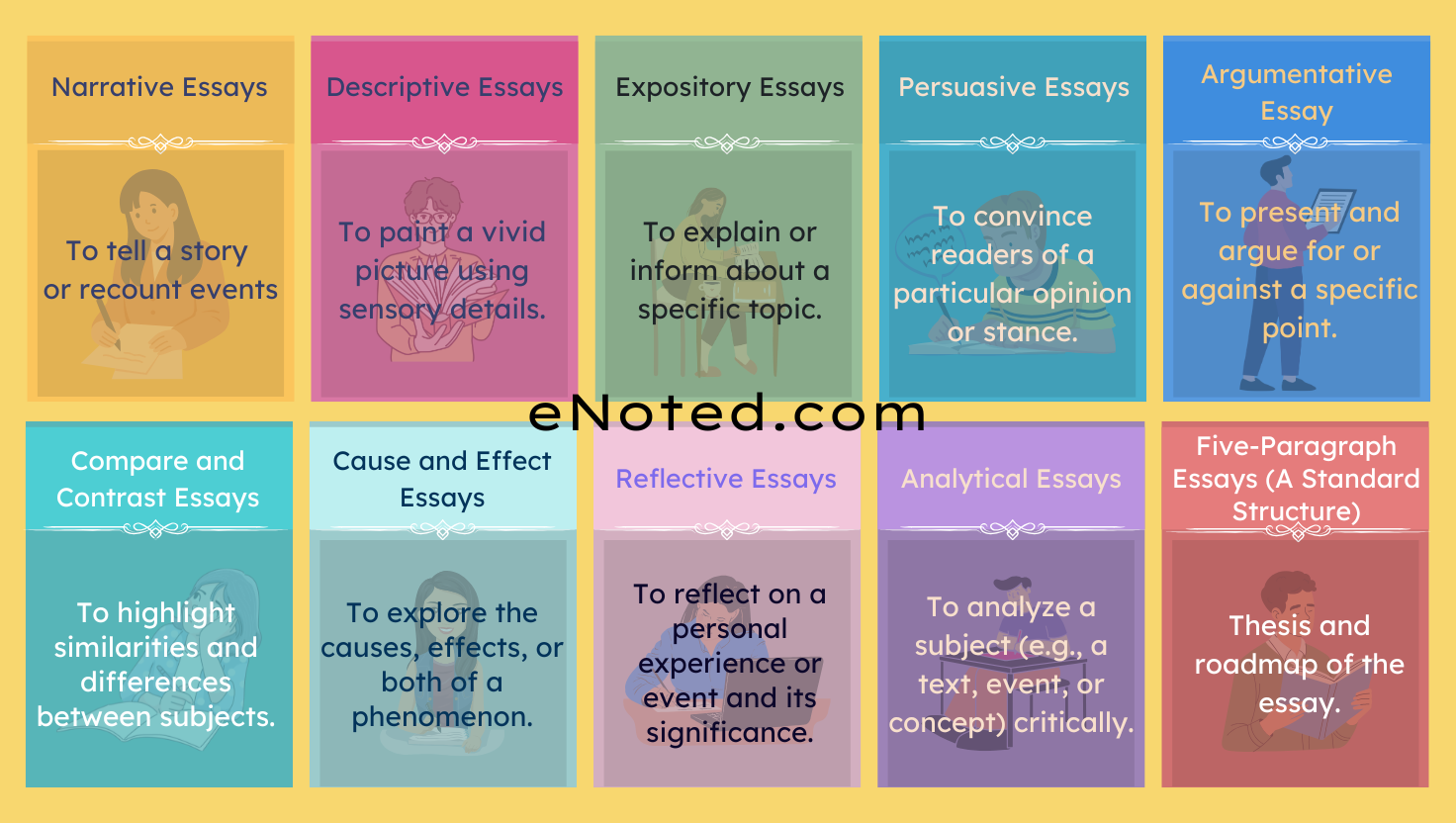
We receive several questions regylarly from students, such as, “What are the essay types?” or “How many types of essays are there?”. To answer their questions we are posting a detailed article.
Essays can be classified into several types, each serving distinct purposes and employing unique formats and tones. Below is an explanation of each type, along with the appropriate formats and tones:
1. Narrative Essays
- Purpose: To tell a story or recount events.
- Format:
- Introduction: Introduces the story, sets the context, and hints at the climax.
- Body: Uses chronological order or logical sequence to describe events.
- Conclusion: Reflect on the story’s significance or lesson learned.
- Tone: Conversational and descriptive, focusing on emotions and sensory details.

2. Descriptive Essays
- Purpose: To paint a vivid picture using sensory details.
- Format:
- Introduction: Sets the scene and establishes the focus.
- Body: Describes the subject with detailed sensory impressions.
- Conclusion: Summarizes the essence of the subject or conveys an overarching feeling.
- Tone: Creative and imaginative, often poetic and vivid.
3. Expository Essays
- Purpose: To explain or inform about a specific topic.
- Format:
- Introduction: Presents the topic and thesis statement.
- Body: Organized into clear sections with facts, data, and analysis.
- Conclusion: Summarizes the information and reinforces the thesis.
- Tone: Formal, objective, and straightforward.
4. Persuasive Essays
- Purpose: To convince readers of a particular opinion or stance.
- Format:
- Introduction: States the argument and captures attention.
- Body: Provides evidence, logical reasoning, and counterarguments.
- Conclusion: Reiterates the argument with a strong closing statement or call to action.
- Tone: Confident, logical, and respectful.

5. Argumentative Essays
- Purpose: To present and argue for or against a specific point.
- Format:
- Introduction: Clearly states the argument and provides background.
- Body: Discuss multiple perspectives with evidence and reasoning.
- Conclusion: Restate the thesis, emphasizing the stronger argument.
- Tone: Analytical, critical, and balanced.
6. Compare and Contrast Essays
- Purpose: To highlight similarities and differences between subjects.
- Format:
- Introduction: Introduces the subjects and purpose.
- Body: Organized by subject (block method) or point (point-by-point).
- Conclusion: Draws overall insights based on the comparison.
- Tone: Analytical and unbiased.
7. Cause and Effect Essays
- Purpose: To explore the causes, effects, or both of a phenomenon.
- Format:
- Introduction: Introduces the phenomenon and its significance.
- Body: Discusses causes, effects, or a mix of both.
- Conclusion: Summarizes findings and may suggest solutions or implications.
- Tone: Logical, factual, and informative.
8. Reflective Essays
- Purpose: To reflect on a personal experience or event and its significance.
- Format:
- Introduction: Sets the stage and introduces the experience.
- Body: Describes the experience and reflects on its impact.
- Conclusion: Summarizes insights and future implications.
- Tone: Personal, introspective, and thoughtful.
9. Analytical Essays
- Purpose: To analyze a subject (e.g., a text, event, or concept) critically.
- Format:
- Introduction: Presents the subject and thesis statement.
- Body: Breaks down the subject into components and discusses each analytically.
- Conclusion: Synthesizes the analysis and reinforces the thesis.
- Tone: Critical, formal, and detailed.

10. Five-Paragraph Essays (A Standard Structure)
- Format:
- Introduction: Thesis and roadmap of the essay.
- Three Body Paragraphs: Each focuses on one main idea with supporting evidence.
- Conclusion: Recaps the thesis and main points, often suggesting broader implications.
- Tone: Varies depending on the type of essay but remains concise and focused.
Conclusion
Each essay type serves unique purposes and uses specific structures and tones to convey its message effectively. By understanding these distinctions, writers can craft essays tailored to their audience and intent. For instance, academic essays prioritize logic and evidence, while narrative and descriptive essays engage the reader through vivid storytelling.